
Robotic Palletizing Systems: Types, Components and Selection Criteria
Define a complete robotic palletizing cell, compare handling concepts, and collect the product, pallet and interface data needed for a proposal.
Updated October 19, 2026: Added detailed guides for unit-load engineering and robot payload, reach and cycle-time calculations.
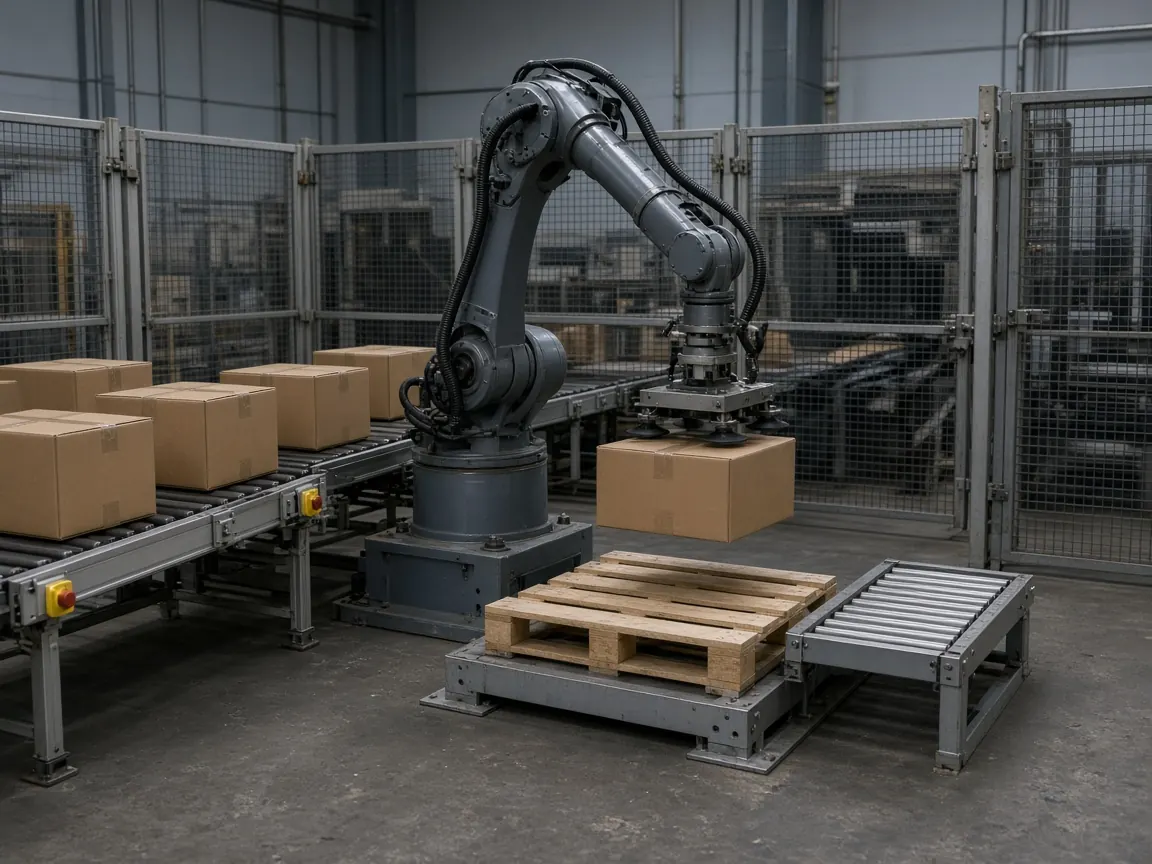
A robotic palletizing system combines a robot, a gripping tool, product presentation, pallet handling, and coordinated controls. The useful purchasing boundary runs from an accepted incoming case to a completed pallet released to the next process. An arm quotation alone does not define that system.
Start by describing what must cross that boundary. A cell receiving sealed cartons in a consistent orientation has a different scope from one that must identify mixed cases, reject damaged packaging, and arrange their arrival order.
Define the system boundary before the robot
OSHA’s robot guidance treats the robot application as including tooling, the workpiece, and safeguards. Our equipment checklist extends that application view to the surrounding material flow so that responsibilities are visible in a proposal.
| Cell function | Buyer input | Proposal should identify |
|---|---|---|
| Case presentation | Orientation, spacing, arrival bursts, barcode quality | Conveyor transfers, sensing, stops, and reject handling |
| Pick and placement | Packaging samples, mass range, dimensions, allowable contact | Robot, tool, utilities, and demonstrated handling envelope |
| Pallet supply | Pallet construction, dimensional variation, condition | Manual or automatic supply, location method, and empty-pallet faults |
| Load building | Pattern, layer count, height, sheets, label orientation | Recipe management, sheet handling, and completion criteria |
| Full-pallet release | Downstream acceptance signal and transport method | Exchange sequence, accumulation, and blocked-outfeed response |
| Human interaction | Replenishment, changeover, cleaning, fault recovery | Risk assessment responsibilities and operating procedures |
Compare the handling concept
A robot can place individual cases or pick a prepared group when the tool and infeed support it. An articulated arrangement and a gantry arrangement organize motion differently; neither label alone tells you whether every required placement is reachable with the proposed tool.
For each proposal, ask for the furthest, highest, and most obstructed placement with a loaded tool. Include incomplete pallets and the tool’s clearance around adjacent cases. A reach circle on a brochure is insufficient to resolve those movements.
Check the load’s footprint and balance with the palletization and unit-load engineering guide, then use the robotic palletizer payload, reach and cycle-time calculations to account for the tool, cases and complete handling motion.
If regular layers can be formed upstream, compare that proposal with a conventional layer palletizer. If the order mixes products, first prepare the mixed-case input data; changing the robot program cannot compensate for missing case information or an unavailable arrival sequence.
Define the rate and the interruptions
State incoming cases per minute, short peak periods, required finished pallets per hour, and the working time available. List what happens during pallet exchange, sheet insertion, replenishment, product changeover, and a blocked downstream conveyor.
Use the throughput calculation to separate an ideal repetitive cycle from scheduled-period output. Ask the supplier to identify which delays the quoted figure includes. A multi-case pick can reduce the number of robot trips while introducing time to collect the group.
Request evidence for the difficult products
Choose samples that challenge the proposed gripper: weak lids, variable surfaces, off-center contents, and the lightest as well as the heaviest package. Have the supplier record the configuration and the handling result. A successful demonstration on one rigid carton does not establish a whole product family.
Before comparing prices, put the same product envelope, pallet rules, layout, interfaces, and acceptance basis into the RFQ checklist. Assign who supplies each component and who verifies the complete cell. Return to the palletizing index for the detailed comparisons that follow those decisions.
Sources and scope
Source dates refer to the material consulted, not independent performance verification.
- OSHA Technical Manual: Industrial Robot Systems and Industrial Robot System Safety
System boundary, application hazards and risk assessment; used as planning guidance, not a compliance certification
undated · Checked October 6, 2026 - MHI: Unit Load Formation Equipment
Pick-and-place and conventional layer/stripper-plate operating principles; historical numeric capacity ranges are not used
undated · Checked October 6, 2026
Published by DeltaSpark. Editorial policy · Corrections and contact
Continue reading
How to Select a Palletizing Gripper for Your Products
Compare vacuum, side-contact and support-based gripping concepts using packaging samples, tool loading, access and repeatable trial records.
Read articleMixed-Case Palletizing: Planning for SKU Variation and Load Stability
Prepare SKU, order and arrival data for mixed-case palletizing, then check support, handling constraints and physical load stability.
Read articlePalletizing Throughput: Estimating Capacity Without Confusing It with Robot Speed
Calculate palletizing capacity from picks, cycle time, pallet exchange and stated downtime assumptions, with a worked example and sensitivity table.
Read article