
Robotic vs. Conventional Palletizers: How to Compare the Options
Compare robotic picking with conventional layer formation using the same products, throughput definition, layout and changeover requirements.
Begin with the unit being transferred. A robotic concept uses a tool to move a case or prepared group. A conventional layer-forming concept arranges a layer and transfers it onto the pallet. Either proposal still needs a workable infeed, pallet exchange, and full-pallet exit.
MHI’s equipment taxonomy describes these operating principles. Its older capacity ranges are not current product ratings and are not used here. This comparison is a set of proposal questions, not a ranking of equipment families.
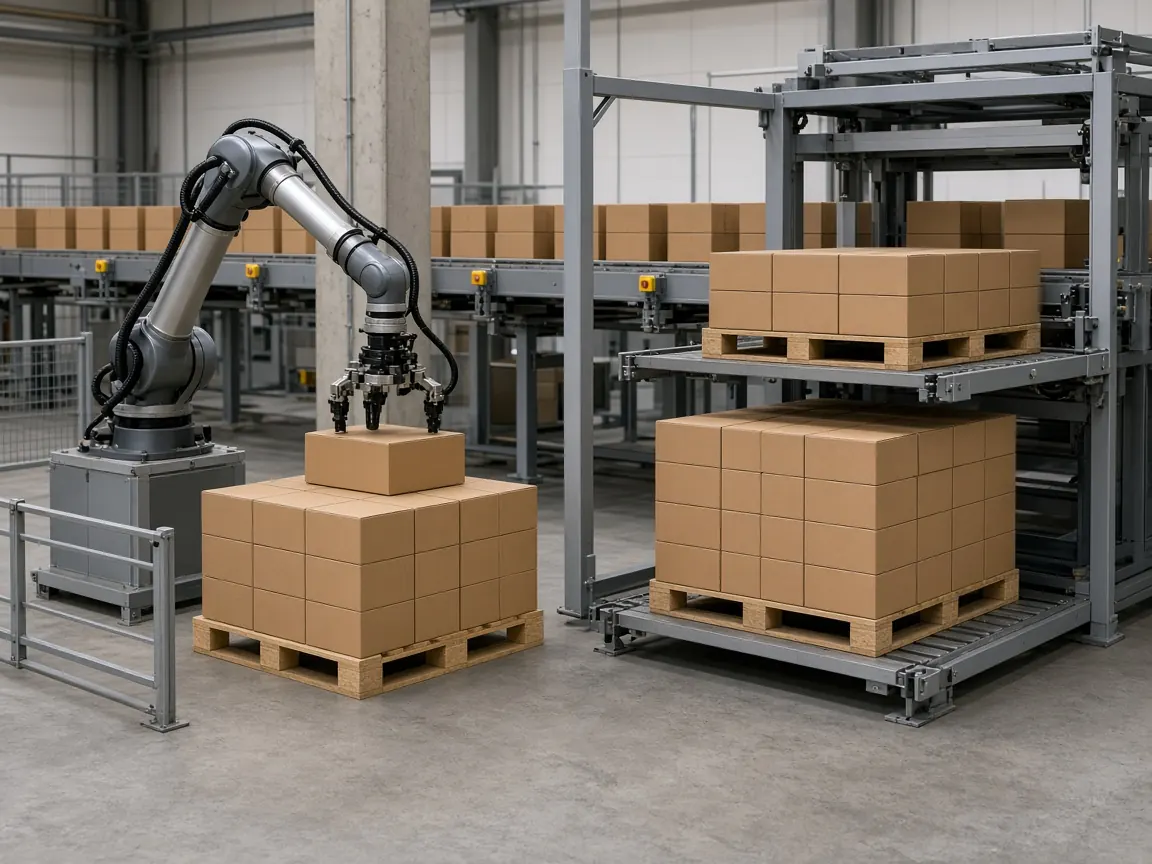
Compare the same production requirement
| Requirement | Ask of the robotic proposal | Ask of the conventional proposal |
|---|---|---|
| Repeated case size and pattern | How many cases are picked together, and how are they presented? | How are rows and layers formed and deposited? |
| Changing case dimensions | Which tool settings, recipes, or hardware change? | Which guides, turning devices, or layer-forming settings change? |
| Mixed orders | How does the planner obtain case data and a feasible arrival sequence? | Can the required mixed arrangement be formed and transferred without damage? |
| Surface and package strength | Where does the tool contact or support the case? | What sliding, turning, accumulation, and transfer contact occurs? |
| Required output | Include group formation, travel, and pallet change | Include layer formation, transfer, and pallet change |
| Available space | Show motion, safeguards, pallet supply, and service access | Show formation lanes, transfer mechanism, pallet supply, and service access |
| Recipe change | Define validation and restart after a new pattern | Define adjustment and validation after a new pattern |
A wide product range can make programmable placement worth investigating. A repetitive layer stream can make layer formation worth investigating. These are starting points: the actual case, transfer method, and complete sequence decide whether either proposal fits.
Put changeover on the comparison sheet
Separate a recipe selection from a mechanical conversion. Record tool changes, guide adjustment, pallet-size changes, label checks, and the first accepted pallet after restart. Ask which changes an operator can perform and which require an integrator.
Use the expected production schedule. If the plant changes products many times during a shift, evaluate total productive time after those changes. If one product runs for long periods, spend more attention on sustained feed, pallet supply, and recovery from ordinary interruptions. Neither situation supports a universal claim that one architecture is faster.
Compare layouts with people and pallets included
Require the same input and output positions on both drawings. Include replenishment space, full-pallet removal, utilities, maintenance clearance, and the proposed access controls. The area occupied by an arm or a layer-transfer mechanism is only part of the installation.
Do not credit a proposal with a small footprint if its pallet queue or case accumulation has been omitted. Likewise, do not count a required shared upstream conveyor against only one option.
Make the shortlist reproducible
Give both suppliers the same product samples and workload. Ask for their longest representative sequence and the assumptions behind their throughput calculation. Record damaged cases, incomplete layers, waiting time, and intervention rather than looking only at a short uninterrupted video.
Prepare the boundary using the system guide, then carry unresolved items into the RFQ. If either supplier cannot show how a difficult package is handled, leave that requirement unresolved rather than awarding a favorable score based on the architecture’s name. More decision guides are in Palletizing.
Sources and scope
Source dates refer to the material consulted, not independent performance verification.
- MHI: Unit Load Formation Equipment
Pick-and-place and conventional layer/stripper-plate operating principles; historical numeric capacity ranges are not used
undated · Checked October 6, 2026
Published by DeltaSpark. Editorial policy · Corrections and contact
Continue reading
Palletizing Throughput: Estimating Capacity Without Confusing It with Robot Speed
Calculate palletizing capacity from picks, cycle time, pallet exchange and stated downtime assumptions, with a worked example and sensitivity table.
Read articleRobotic Palletizing Systems: Types, Components and Selection Criteria
Define a complete robotic palletizing cell, compare handling concepts, and collect the product, pallet and interface data needed for a proposal.
Read article
Palletization Meaning and Unit-Load Engineering: Footprint, Support and Stability
Palletization builds a unit load for handling and transport. Check footprint, package support, center of gravity and restraint before approving a pallet pattern.
Read article