
Palletization Meaning and Unit-Load Engineering: Footprint, Support and Stability
Palletization builds a unit load for handling and transport. Check footprint, package support, center of gravity and restraint before approving a pallet pattern.
Updated October 19, 2026: Initial publication of the footprint, support and restraint checks.
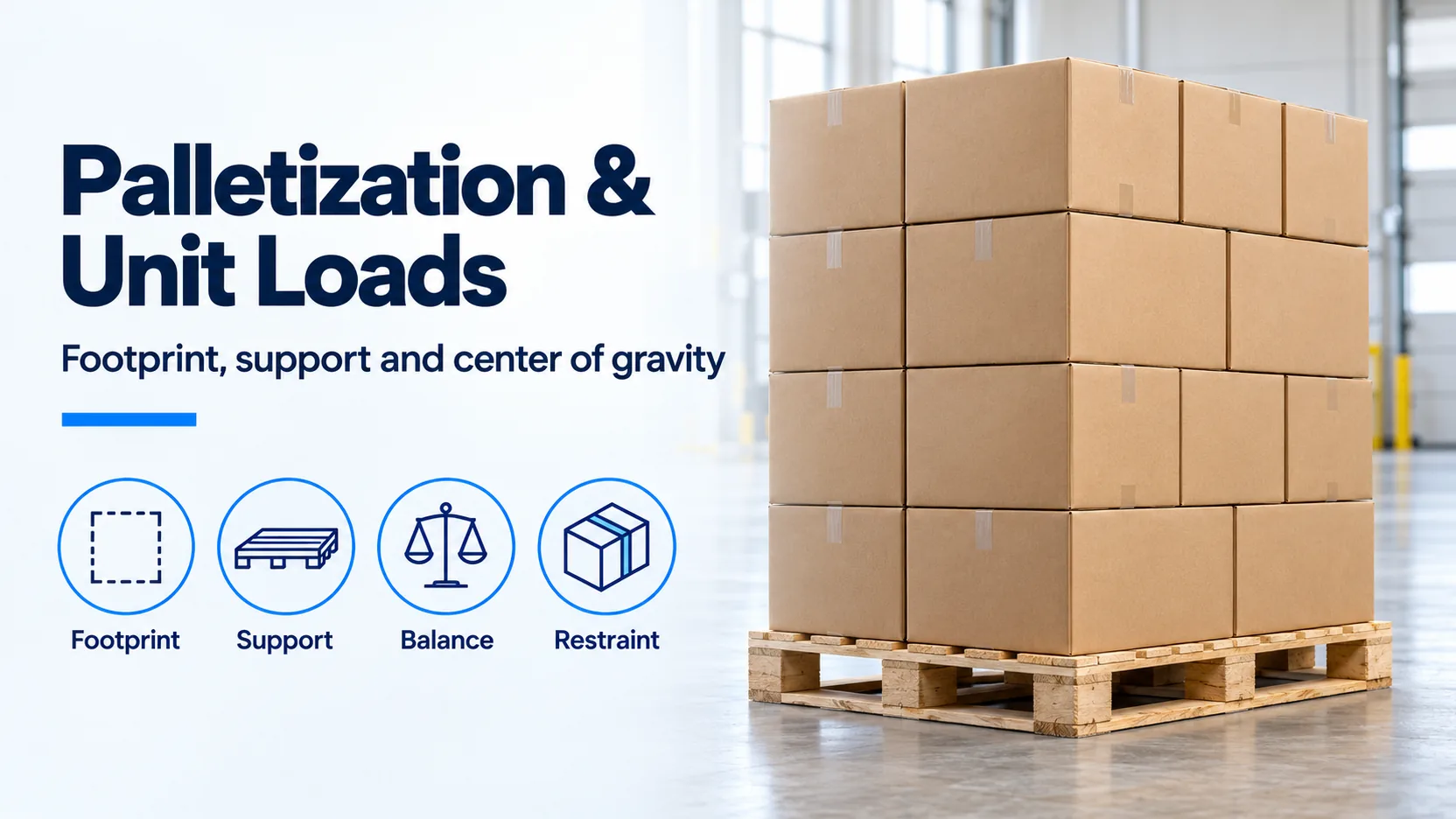
A pallet pattern that fits on a drawing can still produce crushed cases or a shifting stack. Palletization means assembling goods on a pallet into a unit load for handling, storage and transport; unit-load engineering checks the footprint, support, center of gravity and restraint that let those goods move together.
What makes a stack a unit load?
A unit load combines the goods, pallet and any sheets, restraints or protective packaging into the handling arrangement being evaluated. GS1’s logistics-unit definition describes goods grouped for transport or warehousing. Its SSCC identifies that logistics unit; identification does not establish its strength or stability.
The engineering questions are concrete:
- Footprint: Does the outside load envelope fit the permitted pallet and handling space?
- Support: Where do case edges and contents transfer their weight through the stack to the deck?
- Balance: Where is the combined mass located as the load is built and moved?
- Restraint: What limits relative movement between cases and between the load and pallet?
Keep these checks separate from case counts. The GS1 US framework defines TI as cartons per layer and HI as layers per pallet, and includes the pallet itself in pallet-level gross weight. Those data fields describe a load; they do not approve a stacking pattern. The palletizing topic index connects this load-design work to the machinery that builds it.
Calculate the footprint before increasing the layer count
Footprint is the outside plan-view envelope, including any bulge or projecting packaging. For an unrotated rectangular grid, calculate the remaining edge clearance before treating a proposed case count as feasible.
Formula: cL = (Lp − nL × l) / 2 and cW = (Wp − nW × w) / 2.
Here Lp and Wp are usable pallet length and width in millimeters; l and w are filled-case dimensions in millimeters; nL and nW are case counts along those axes. The clearance c is per edge for a centered layer. This formula assumes no gaps, rotation or deformation.
Worked example — editorial assumptions dated October 19, 2026: Assume a usable pallet footprint of 1,200 mm × 1,000 mm, filled cases of 400 mm × 300 mm, and a centered grid of 3 cases × 3 cases, with no permitted overhang. Then cL = (1,200 mm − 3 × 400 mm) / 2 = 0 mm and cW = (1,000 mm − 3 × 300 mm) / 2 = 50 mm. These are chosen calculation inputs, not standard pallet dimensions prescribed here or measured product data.
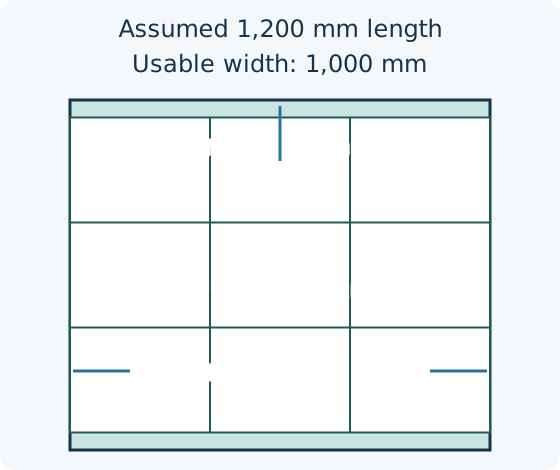
Assumed footprint example. Solid case rectangles show the occupied envelope; shaded strips show unused width. A deck outline does not show deck-board support.
Threshold rule: If either calculated edge clearance is less than 0 mm under a no-overhang requirement, choose a revised orientation, fewer cases or a different approved pallet footprint, because the proposed layer extends beyond its permitted envelope. A result of 0 mm, as in the assumed lengthwise calculation, leaves no allowance for dimensional variation; use the largest permitted filled-case envelope before accepting it.
This is a geometric screen. A case can remain within the outline while bridging deck gaps or resting on weak portions of the cases below it. Check the actual pallet construction and the package’s supported contact areas next.
Locate the center of gravity and the load path
The center of gravity describes where the combined mass acts; it is not necessarily the geometric center of the stack. Uneven contents, heavy upper layers or unequal case masses can move it vertically and sideways.
Mass-balance formula: xCG = Σ(mi × xi) / Σmi, with the same expression for yCG and zCG. Use masses mi in kilograms and coordinates in millimeters from one common datum, including the pallet and other components. The resulting coordinates are in millimeters. This is a mechanics calculation, not a transport acceptance limit.
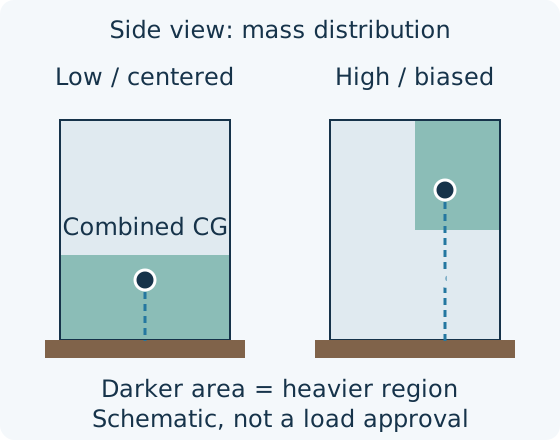
Conceptual mass distributions, not calculated load designs. Dots represent combined centers of gravity; dashed lines show their vertical projections. Neither drawing establishes resistance to sliding or tipping.
The NIST mixed-pallet paper treats center of gravity as a pallet-wide metric and support, overhang and pressure as package-level metrics. It also warns that interlocking can reduce the carrying capacity of cardboard packages. Rotating alternate layers therefore requires a package-support review, even when it appears to tie the load together.
As an engineering consequence, review both the completed pallet and partially built states. A centered final load can pass through an uneven intermediate arrangement. Restraint selection must address the intended handling conditions, package friction and deformation; a center-of-gravity coordinate alone does not establish acceptable transport performance.
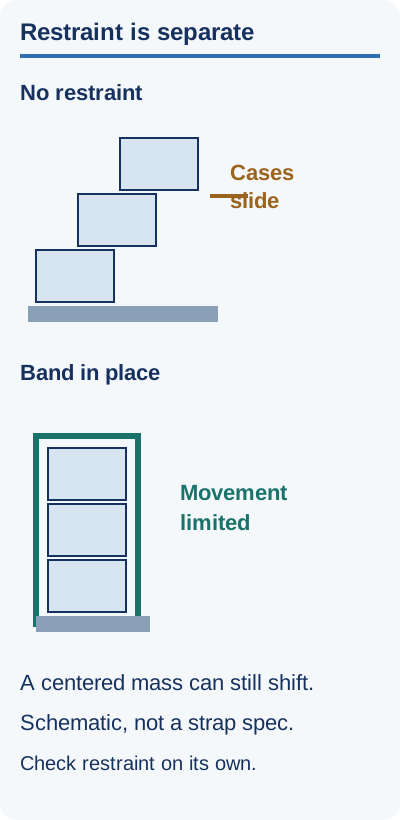
Restraint is separate from the center-of-gravity coordinate. Schematic, not a strap specification.
Separate the failure modes before approving the recipe
Approve the recipe against each physical constraint, rather than treating a high case count as the objective by itself.
| Check | Failure mode | Prevention or evidence needed |
|---|---|---|
| Outside footprint | Projecting cases encounter adjacent loads or handling equipment | Filled-case envelope and permitted overhang at every layer |
| Vertical support | Case edges lose support and lower packages crush | Package compression evidence and a support map for each layer transition |
| Mass distribution | An uneven or high stack becomes sensitive to handling disturbances | Actual mass distribution, handling conditions and load evaluation |
| Restraint and contact | Cases slide or the load separates from its pallet | Restraint design evaluated with representative packaging and pallet surfaces |
| As-built consistency | Wrong orientations or missing cases change the intended load | Recipe checks, product identification and interruption recovery |
The hidden cost of a dense but fragile pattern is rehandling: rebuilding leaning pallets, replacing damaged packaging and interrupting outfeed. Record recovery labor and blocked-line time separately from nominal palletizer output. The live throughput calculation guide explains where those interruptions enter the available production time.
For the engineering handover, retain the filled-case drawing, mass distribution, pallet construction, layer maps, overall load limits, restraint specification and the intended handling conditions. For loads containing different products, use the mixed-case palletizing guide to describe the build sequence and product data before programming placements.
Method and source scope
This guide combines GS1 terminology with NIST’s distinction between package and pallet-wide constraints. The footprint and mass-balance equations are explicit engineering calculations; the numeric footprint example is an assumed geometry, not an OEM specification. Sources checked October 19, 2026.
Sources and scope
Source dates refer to the material consulted, not independent performance verification.
- GS1: What is a Logistics unit and how is it identified?
A logistics unit combines goods for transport or warehousing and is individually identified by an SSCC; used for terminology, not structural approval
Updated August 22, 2024 · Checked October 19, 2026 - GS1 US National Data Quality Program: Framework
The glossary defines TI and HI and states that pallet-level gross weight includes the pallet; used for data definitions only
R1.0, February 12, 2015, glossary pages 23–24 · Checked October 19, 2026 - NIST: Mixed Pallet Stacking, an Overview and Summary of the 2010 PerMIS Special Session
Sections 4.1–4.3 distinguish package support, overhang, pressure and pallet-wide center of gravity; interlocking can reduce cardboard package load capacity
2010 PerMIS paper, NIST publication record dated February 4, 2011 · Checked October 19, 2026
Published by DeltaSpark. Editorial policy · Corrections and contact
Continue reading
Mixed-Case Palletizing: Planning for SKU Variation and Load Stability
Prepare SKU, order and arrival data for mixed-case palletizing, then check support, handling constraints and physical load stability.
Read articlePalletizing Throughput: Estimating Capacity Without Confusing It with Robot Speed
Calculate palletizing capacity from picks, cycle time, pallet exchange and stated downtime assumptions, with a worked example and sensitivity table.
Read articleRobotic Palletizing Systems: Types, Components and Selection Criteria
Define a complete robotic palletizing cell, compare handling concepts, and collect the product, pallet and interface data needed for a proposal.
Read article