
How to Select a Palletizing Gripper for Your Products
Compare vacuum, side-contact and support-based gripping concepts using packaging samples, tool loading, access and repeatable trial records.
Select a palletizing gripper by the surfaces it can contact, the load it must retain, and the path it must travel. A case’s mass is one input. Packaging stiffness, porosity, lid closure, and accessible support surfaces can change which gripping concept is practical.
The comparison below identifies sample tests to request. It does not specify a finished tool, a safe holding force, or an allowable acceleration for an unknown package.
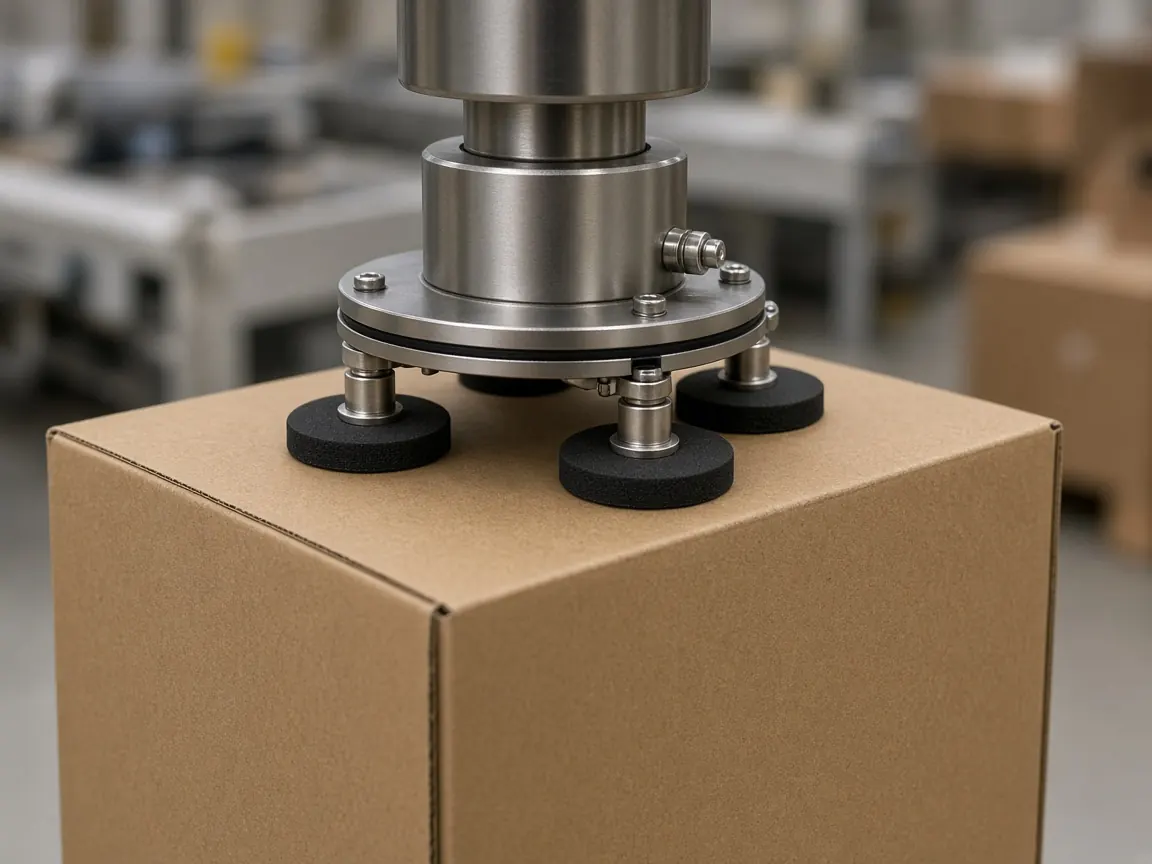
Start with production samples
Collect filled cases at the limits of the product range. Include surface coatings, tape seams, printing, vents, damaged-but-acceptable packaging, and the expected range of fill mass. Photograph the permitted grip zones and any surfaces that must remain untouched.
For vacuum concepts, an apparently flat surface may still leak. Schmalz’s vacuum guidance distinguishes airtight and porous workpieces and identifies suction flow and area as relevant for porous material. Its example operating values are not transferred here to your cartons. Ask for measurements on your packaging rather than selecting a cup from mass alone.
Compare possible contact methods
| Concept | Condition worth investigating | Question that can rule it out |
|---|---|---|
| Vacuum contact | An accessible surface can form a usable suction interface | Does leakage, a vent, flap movement, or deformation prevent reliable retention? |
| Side-contact grip | The package permits controlled side contact | Does the required contact damage the carton or contents, or allow slipping? |
| Under-support or fork-style concept | A support surface can be reached and later released | Can the tool enter and withdraw without trapping itself or disturbing adjacent cases? |
| Combined concept | One method alone leaves an unresolved handling constraint | Do the added mass, utilities, and mechanisms create new reach or recovery problems? |
These are concept-level questions. A package may fit more than one approach, or none of them without a change to presentation or packaging. Do not treat the rows as interchangeable catalog products.
Check the tool with the robot and pattern
Give the integrator the complete carried assembly: tool, adapter, valves, hoses, sensors, and product. Ask for verification against the selected robot’s loading documentation, including offsets and the intended movement. Leave the numerical limits to the applicable manufacturer documentation.
Show the tool approaching and leaving the tightest placement in the pallet pattern. A grip that works at an open test bench may be unable to release a case between neighboring packages. Include empty-pallet handling or slip-sheet handling only if the proposed tool actually performs those tasks.
Make the trial record useful
| Record | Capture during the trial |
|---|---|
| Sample identity | SKU, packaging revision, filled mass, surface and condition |
| Configuration | Tool revision, contact locations, utilities and motion program |
| Operating conditions | Pick orientation, travel, acceleration settings and placement |
| Observations | Missed picks, slips, deformation, damaged contents and release disturbances |
| Exceptions | Response to a failed grip, missing case, or interrupted sequence |
| Coverage | Number of attempts and which product variations were exercised |
The supplier and project team should agree the acceptance limits and sample coverage before testing. A short demonstration cannot establish an unmeasured failure rate. Any proposed loss-of-power or fault test needs an approved test procedure and suitable controls; this page is not an instruction to release a load.
OSHA includes end-effector and released-workpiece hazards in its robot application guidance. Carry the selected concept into the application’s risk assessment, not just its output calculation.
Provide samples, allowable contact zones, pallet patterns, and the required throughput with the RFQ. Use the palletizing index to connect the tool decision to the full cell design.
Sources and scope
Source dates refer to the material consulted, not independent performance verification.
- Schmalz: Energy Required for Vacuum Generation
Porous packaging requires consideration of suction flow and effective area; no model parameters are reproduced
undated · Checked October 6, 2026 - OSHA Technical Manual: Industrial Robot Systems and Industrial Robot System Safety
System boundary, application hazards and risk assessment; used as planning guidance, not a compliance certification
undated · Checked October 6, 2026
Published by DeltaSpark. Editorial policy · Corrections and contact
Continue reading
Mixed-Case Palletizing: Planning for SKU Variation and Load Stability
Prepare SKU, order and arrival data for mixed-case palletizing, then check support, handling constraints and physical load stability.
Read articlePalletizing Throughput: Estimating Capacity Without Confusing It with Robot Speed
Calculate palletizing capacity from picks, cycle time, pallet exchange and stated downtime assumptions, with a worked example and sensitivity table.
Read articleRobotic Palletizing Systems: Types, Components and Selection Criteria
Define a complete robotic palletizing cell, compare handling concepts, and collect the product, pallet and interface data needed for a proposal.
Read article