
Cobot vs. Industrial Robot Palletizing: Questions to Resolve Before Selection
Evaluate palletizing loads, tool reach, worker interaction and protective measures before comparing collaborative and separated robot cells.
A “cobot” label does not establish that a palletizing installation can operate beside people without additional protective measures. Decide first whether direct human interaction is part of the task, then evaluate the complete application and its required output.
Collaborative applications are part of industrial robotics. The common buying comparison is between a collaborative-capable robot arrangement and a cell designed to separate people from automatic motion. Those categories do not provide a universal payload, speed, or floor-space limit.
Specify the human task
OSHA’s technical manual distinguishes applications by worker interaction and calls for risk assessment across the application lifecycle. It considers the end-effector and workpiece as well as the robot. Use that application-level approach when requesting engineering evidence; this article does not certify a cell or prescribe protective settings.
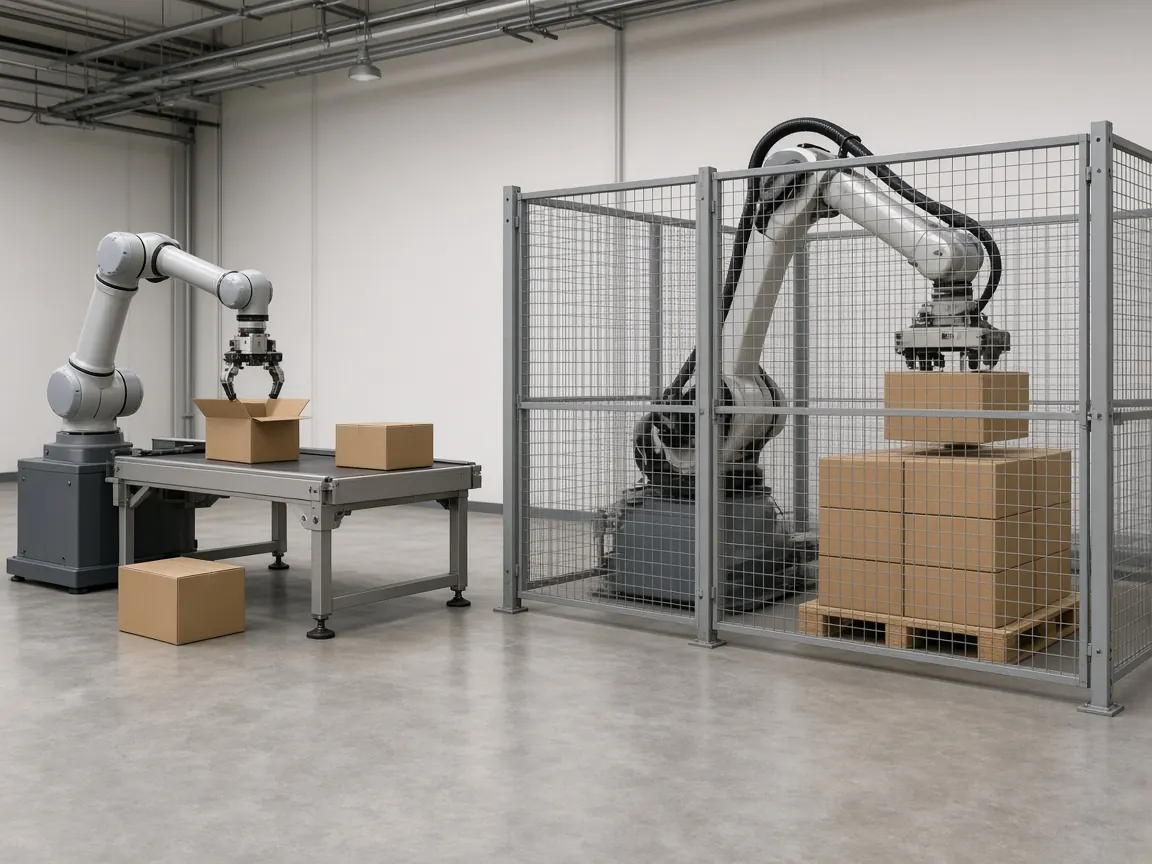
Write down why someone must approach: replenish pallets, add sheets, clear a fault, inspect a load, or share an actual handling task. Record whether automatic motion is intended to continue during that interaction. Occasional access for replenishment does not by itself prove that the process requires collaborative motion.
Ask for configuration-specific evidence
| Item to resolve | Information to request | What remains unknown without it |
|---|---|---|
| Carried load | Tool, adapter, hoses and product masses; offsets and loading limits | Whether a named payload rating covers the real tool and load |
| Reach and height | Loaded-tool path to every required pallet position | Whether the full pattern can be built without interference |
| Package behavior | Retention tests and allowed surface/contact conditions | Whether a shifting or released case creates an additional hazard |
| Worker interaction | Task list and application risk assessment | Which hazards and operating modes have been considered |
| Protective measures | Documented functions, configuration, verification responsibilities | Whether the proposed application has been adequately assessed |
| Output | Measured or modeled cycle with intended measures active | Whether an unrestricted demonstration represents production |
| Recovery | Documented response to mis-picks, incomplete pallets and stops | How ordinary exceptions affect work and output |
These requests deliberately avoid generic safe-speed or safe-force numbers. The responsible parties must determine the applicable requirements using current equipment documentation, the installation, and its jurisdiction.
Include the product in the assessment
A tool with a smooth exterior can still carry a carton whose corners, contents, or position create hazards. A pallet adds changing geometry as the stack grows. Record the largest and smallest products and the locations where people may approach or become trapped against other equipment.
Do not use a brochure image of a person near an unloaded arm as evidence for a loaded palletizing operation. Ask which configuration was assessed and what changes would require reassessment.
Compare accepted production, not the demo setting
Request output for the agreed pattern and operator activity. If a protective response changes motion or pauses production, that behavior belongs in the capacity model. If a separated layout needs extra pallet handling or access space, include that scope as well.
Start with the complete-system boundary and gripper inputs. Put the intended human tasks, product envelope, pallet height, and acceptance responsibilities in the RFQ checklist. The palletizing index connects these application questions to the other selection decisions.
Sources and scope
Source dates refer to the material consulted, not independent performance verification.
- OSHA Technical Manual: Industrial Robot Systems and Industrial Robot System Safety
System boundary, application hazards and risk assessment; used as planning guidance, not a compliance certification
undated · Checked October 6, 2026
Published by DeltaSpark. Editorial policy · Corrections and contact
Continue reading
How to Select a Palletizing Gripper for Your Products
Compare vacuum, side-contact and support-based gripping concepts using packaging samples, tool loading, access and repeatable trial records.
Read articleRobotic Palletizing Systems: Types, Components and Selection Criteria
Define a complete robotic palletizing cell, compare handling concepts, and collect the product, pallet and interface data needed for a proposal.
Read article
Palletization Meaning and Unit-Load Engineering: Footprint, Support and Stability
Palletization builds a unit load for handling and transport. Check footprint, package support, center of gravity and restraint before approving a pallet pattern.
Read article