
Roller vs. Chain Pallet Conveyors: What to Check Before Specifying a System
Compare roller and chain pallet transport by underside support, travel direction, transfer geometry and loaded-pallet acceptance trials.
Compare roller and chain pallet conveyors by how the pallet underside is supported in the required travel direction. Total load mass is necessary, but it cannot establish whether a runner spans the supports, catches at a transfer or reaches a station in the right orientation.
This is a specification guide for horizontal pallet handling. It contains no LINEVO pallet-conveyor model claim and gives no load rating for an unspecified machine.
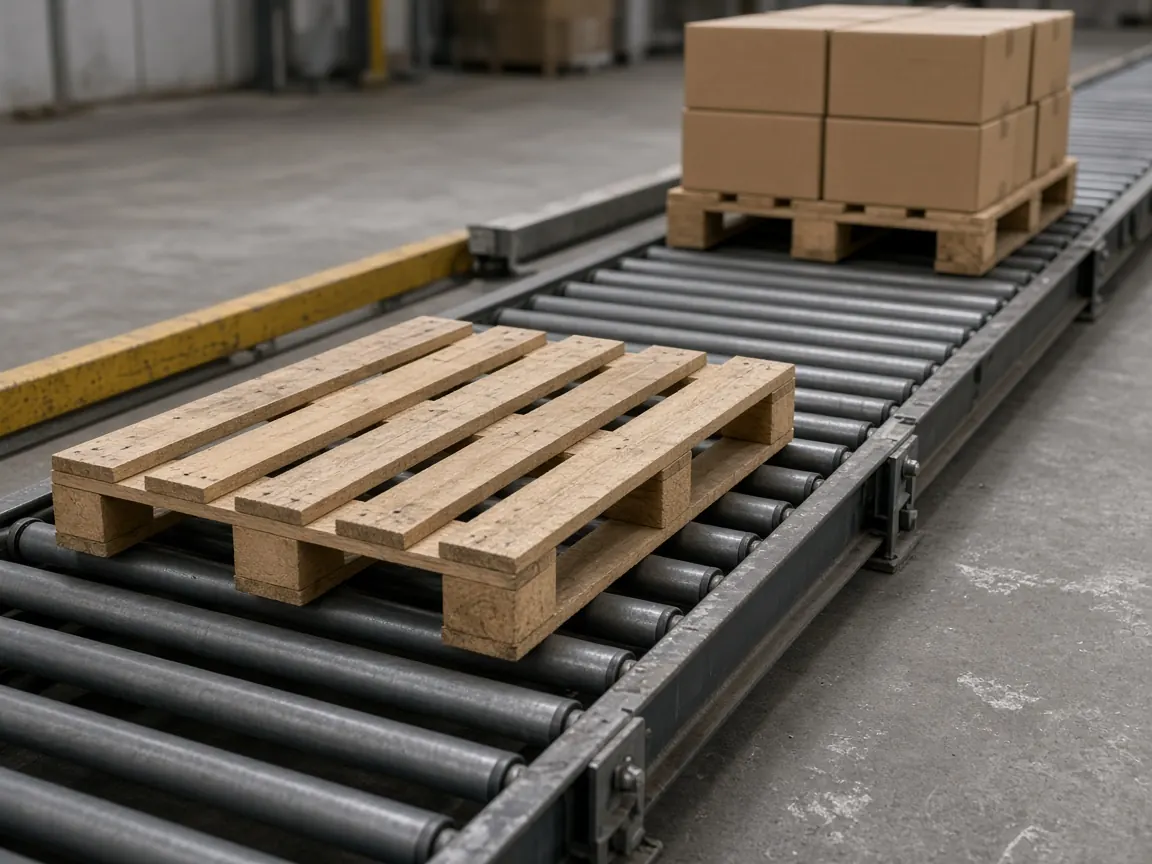
Illustrative photograph. This is a selection sequence, not a machine design or load-rating chart.
Start with an underside drawing
Provide the pallet’s bottom deck or runner arrangement, dimensions, material and permitted condition. Identify openings, protruding fasteners, repaired areas and any allowed variation across pallet suppliers. State whether the same line carries empty pallets and loaded pallets.
A support drawing should show the pallet at entry, normal travel, transfer and final positioning. If the project changes travel direction, repeat the support review in the new orientation. A pallet accepted along one route is not automatically accepted across a right-angle transfer.
Compare the contact arrangement
| Question | Roller arrangement | Chain-strand arrangement |
|---|---|---|
| Where is support applied? | Across the selected roller positions beneath the pallet | Along the selected chain tracks beneath the pallet |
| What geometry matters? | Roller spacing, transfer gaps and underside members crossing them | Track spacing, underside contact paths and transfer alignment |
| How is load distributed? | Verify which rollers actually carry the loaded pallet | Verify how the pallet transfers load to the supporting strands |
| How does direction change? | Require the proposed lift, transfer or turning arrangement | Require the proposed transfer arrangement and new support orientation |
| What proves compatibility? | Actual pallet samples through the complete conveyor path | The same samples and conditions, including transitions |
The Interroll pallet platform catalog illustrates roller and chain modules as different arrangements within pallet systems. That does not establish a universal rule that one carries every pallet better. Its model ratings are not used here.
Give empty pallets their own trial
An empty pallet can arrive skewed or behave differently from a loaded one. Include the pallet dispenser or manual loading point, if used, and define orientation detection, failed-transfer handling and acceptable pallet condition. Ask how the system identifies a pallet outside the agreed envelope before it reaches a critical transfer.
For loaded pallets, provide the load footprint, center-of-mass information where relevant, overhang and load stability before wrapping. The stretch-wrapper integration guide addresses the unwrapped-load handoff after palletizing.
Define the station and access boundaries
Specify the final position needed by the palletizer, wrapper, lift or mobile robot. Agree how the receiving station detects arrival and grants transfer permission. Where a forklift interacts with the conveyor, the project layout and risk assessment must address vehicle access and personnel exposure; the conveyor comparison does not settle those engineering decisions.
Discuss abnormal conditions: a pallet stops across a boundary, a station loses communication, or downstream space fills. Name the supplier responsible for each recovery sequence and obtain the corresponding instructions. Do not accept a handoff described only as “standard interface.”
Assemble a comparable enquiry
Send underside drawings and physical pallet samples, loaded and empty masses, load dimensions, direction changes, station positions, required accepted flow and proposed rejection criteria. Ask each supplier to return a support drawing, included-module list, controls boundary and trial plan against the same inputs.
Carry those interfaces into the line integration record and the RFQ checklist. The material-handling guides cover cartons and mobile transport separately.
Sources and scope
Source dates refer to the material consulted, not independent performance verification.
- Interroll modular pallet conveyor platform catalog
Roller and chain conveying arrangements and pallet handling interfaces. No equipment ratings reused.
October 2024 · Checked October 6, 2026
Published by DeltaSpark. Editorial policy · Corrections and contact
Continue reading
Connecting Packaging Machines, Conveyors and Palletizers: An Integration Checklist
Assign mechanical, controls and fault-recovery interfaces between packaging machines, conveyors and palletizers before approving the line design.
Read articlePlanning Stretch-Wrapping Integration After Palletizing
Specify pallet transfer, unwrapped-load behavior, film containment and release criteria when connecting a stretch wrapper to a palletizer.
Read articleAGV vs. AMR for Factory Transport: How to Frame the Decision
Compare factory mobile transport by mission, route behavior, load transfer, fleet interfaces and recovery tests rather than the AGV or AMR label.
Read article