
AGV vs. AMR for Factory Transport: How to Frame the Decision
Compare factory mobile transport by mission, route behavior, load transfer, fleet interfaces and recovery tests rather than the AGV or AMR label.
Specify the transport mission before comparing AGV and AMR proposals. The labels are useful starting points: an AGV proposal commonly emphasizes guided routes, while an AMR proposal commonly emphasizes autonomous navigation. Automate UK’s terminology guide explains the navigation distinction. Neither label establishes how the offered system behaves at a blocked aisle, a busy crossing or a machine handoff. Require the supplier to demonstrate those behaviors.
This guide frames a factory-transport procurement decision. It does not identify a LINEVO mobile-robot offering, certify a vehicle or prescribe a site safety design.
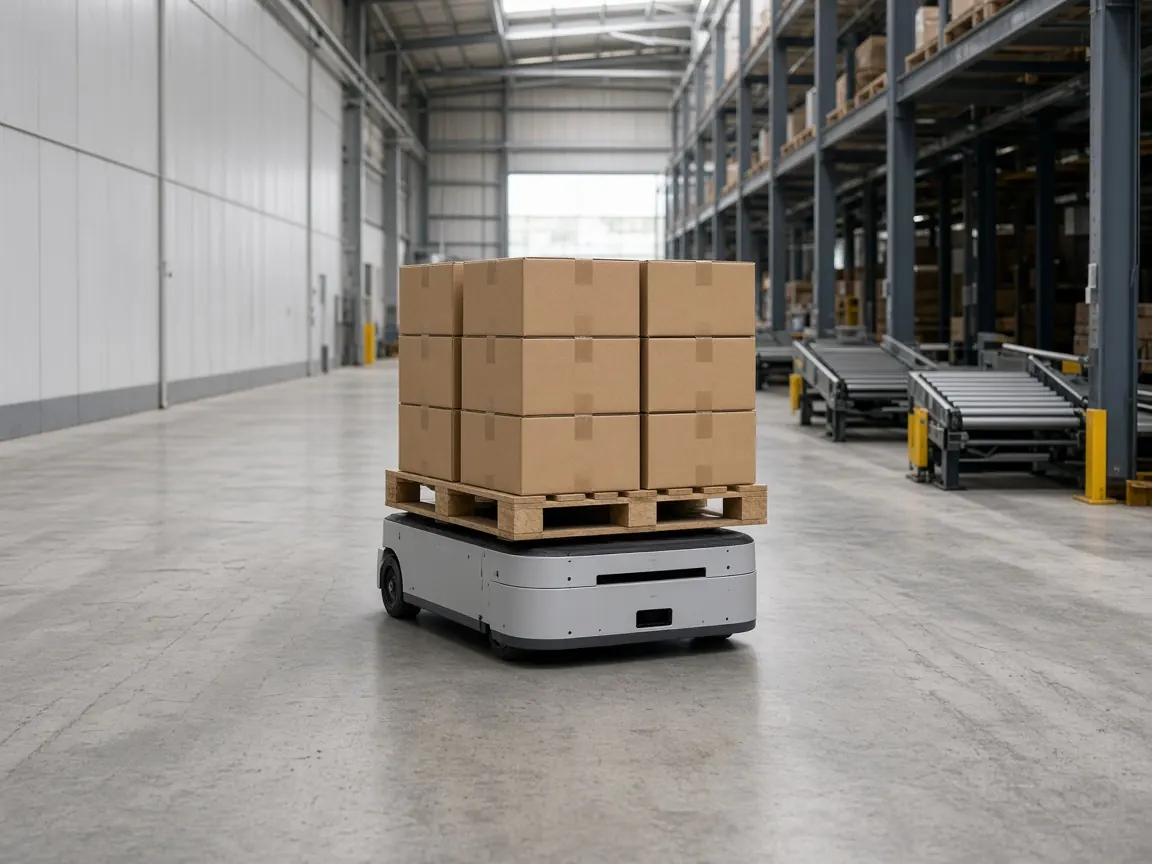
Illustrative photograph. Assess the complete mission and recovery behavior, not vehicle travel speed alone.
Write the mission as an origin, destination and transfer
Define what is transported, how it is supported and what equipment loads and unloads it. A pallet collected from a fixed conveyor is a different mission from a trolley exchange or a manually loaded shelf. Record the handling unit’s dimensions, mass, stability and required docking condition.
Map the route’s aisle widths, intersections, doors, floor transitions and shared traffic. State the expected mission frequency and the demand peaks. Ask suppliers to identify all assumptions used to estimate the number of vehicles; charging, queueing, transfer time and recovery work must appear in that explanation.
Compare observable behavior
| Decision | Question for each proposal | Evidence to request |
|---|---|---|
| Route definition | Who defines routes, permitted areas and changes? | Site-map workflow and change responsibility |
| Blocked path | Does the system wait, reroute or ask an operator? | Demonstration with defined obstacles and traffic rules |
| Machine docking | What alignment and transfer conditions must hold? | Interface drawing and repeated loaded transfers |
| Task allocation | How are priorities, queues and completed missions managed? | Mission trace under the planned demand pattern |
| Infrastructure loss | What happens if communication, localization or a station becomes unavailable? | Supplier-defined fault and recovery demonstration |
| Expansion | What additional configuration, licensing and validation are needed? | Written scope for the proposed expansion scenario |
Treat this as a common test brief for both categories. A supplier may offer useful route flexibility without permitting every possible detour, and a guided-route system may suit a stable repetitive mission. Select the behavior that serves the task rather than treating autonomy as an automatic benefit.
Separate navigation from fleet communication
VDA’s April 2026 announcement describes version 3.0 of VDA 5050 as an extension of the mobile-robot communication interface that better accommodates higher autonomy. The official specification repository publishes version 3.0.0.
For a project using VDA 5050, record the agreed version, supported messages, actions and error handling on both the fleet-control and vehicle sides. A claim of protocol support alone does not prove a mixed fleet works at your stations. Ask for a compatibility demonstration with the intended software versions. Communication compatibility also does not establish the application’s safety performance.
Test the busy period and the recovery work
Require a mission log showing completed tasks, queue time, charging intervals and exceptions over the agreed trial. Include an unavailable destination, a blocked route, a stopped receiving machine and recovery after an interruption. Observe who must intervene and how long the handling station remains unavailable; a vehicle’s travel speed alone cannot describe the completed-mission rate.
Use representative loads and the actual transfer arrangement. The site risk assessment must address people, other vehicles, access points and the surrounding machinery. This article supplies enquiry questions, not a substitute procedure for operating or recovering a mobile robot.
Prepare the mission list, route drawing, load data, shift-demand profile, docking interfaces, site traffic rules and acceptance scenarios. Compare fixed transport through the pallet-conveyor guide where the mission permits it, and gather project inputs with the RFQ checklist. Return to material handling for the remaining transport decisions.
Sources and scope
Source dates refer to the material consulted, not independent performance verification.
- VDA: Version 3.0 of VDA 5050 released
Mobile-robot fleet communication and support for higher autonomy in version 3.0.
April 20, 2026 · Checked October 6, 2026 - VDA 5050 official specification
Order and status communication interface; version and implementation scope must be agreed.
3.0.0 · Checked October 6, 2026 - Automate UK / BARA: Guide to AGVs and AMRs
Terminology and guided navigation versus autonomous mobile robot navigation; no product performance comparison.
undated · Checked October 6, 2026
Published by DeltaSpark. Editorial policy · Corrections and contact
Continue reading
Roller vs. Chain Pallet Conveyors: What to Check Before Specifying a System
Compare roller and chain pallet transport by underside support, travel direction, transfer geometry and loaded-pallet acceptance trials.
Read articleHow to Select Conveyors for Cartons and Cases
Prepare carton dimensions, base condition, route and accumulation requirements to compare conveyor proposals and test difficult transfers.
Read article