
Planning Stretch-Wrapping Integration After Palletizing
Specify pallet transfer, unwrapped-load behavior, film containment and release criteria when connecting a stretch wrapper to a palletizer.
Plan the transfer of the unwrapped load before selecting the wrapper interface. The pallet must leave the palletizer, cross the transfer and reach the wrapping position while its contents are still in the condition produced by palletizing. A final wrapping recipe cannot correct a load that has already shifted during that journey.
This guide covers the project handoff and validation questions. It does not claim a LINEVO stretch-wrapper product or prescribe a machine’s operating settings.
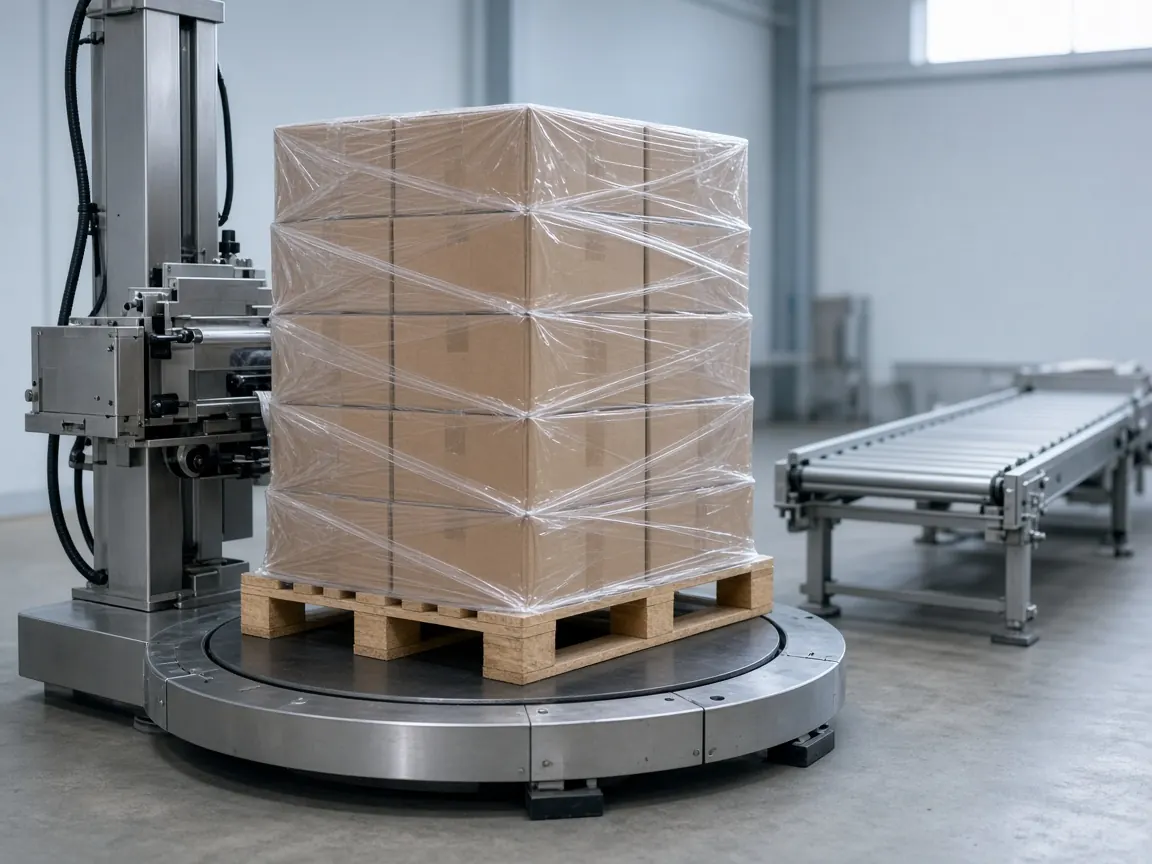
Illustrative photograph. The unwrapped transfer needs validation before the final wrap is applied.
Define the pallet and the load separately
Record pallet footprint, underside construction, condition and entry direction. Then record load footprint, height, mass distribution, overhang or underhang, surface features and the palletizing pattern. Different products on the same pallet size can behave differently during transfer and wrapping.
| Boundary | Question to resolve | Acceptance evidence |
|---|---|---|
| Palletizer discharge | Is the pattern complete and identified before release? | Completed-load signal and recipe record |
| Transfer conveyor | Does the pallet remain supported through gaps and changes of direction? | Drawing and trial with representative pallets |
| Wrapper entry | Can the unwrapped load reach and stop at the agreed position without unacceptable movement? | Observed transfer and stop trial |
| Wrapping cycle | What containment and film placement does this load require? | Agreed recipe and containment checks |
| Discharge | What must pass before the load is released? | Film-tail, identification and load-condition inspection |
Select the wrapping arrangement around load behavior
If the proposed arrangement rotates the load, request a trial of that motion with the least stable representative load. If the proposal keeps the load stationary while film moves around it, inspect the transfer into and out of the wrapping position just as carefully. A stationary wrapping cycle does not remove the earlier conveyor handoff.
The project must also define film threading and replenishment access, handling of interrupted cycles and removal of a rejected load. These access requirements belong on the layout before adjacent guarding and conveyors are finalized.
Evaluate containment rather than appearance alone
Lantech’s stretch-wrapping guide explains containment force as a combination of film wrap force and the film layers applied. The procurement implication is to agree a measurement approach for the actual load rather than judge a pallet only by how tightly the film appears to fit. This article does not transfer a supplier’s recommended force or recipe to an untested load.
Ask the packaging specialist to identify the measurement locations, load types, storage interval and handling sequence used for acceptance. Record film identity and machine recipe with the result. Include label readability, film tails and any required pallet-to-load connection in the inspection criteria.
Check that wrapping capacity includes the handoffs
Define capacity using the full occupied cycle: entry, positioning, wrapping, completion checks and exit. Also agree the assumptions for film replenishment, pallet spacing, recipe changes and stopped downstream equipment. An isolated wrapping-cycle time cannot establish the accepted-pallet rate of the connected line.
Ask where completed loads wait if dispatch stops, and what happens when that space is full. The pallet-conveyor comparison covers the underside and support information needed at this interface.
Prepare pallet drawings and samples, load patterns, film information, required accepted pallets per shift, the planned transfer route and proposed release criteria. Add these to the packaging integration checklist and select trial conditions in the FAT/SAT guide. Further process decisions sit in end-of-line packaging.
Sources and scope
Source dates refer to the material consulted, not independent performance verification.
- Lantech: Quick guide to stretch wrapping
Load containment and wrap verification principles; no wrapper model performance claims.
undated · Checked October 6, 2026 - Interroll modular pallet conveyor platform catalog
Roller and chain conveying arrangements and pallet handling interfaces. No equipment ratings reused.
October 2024 · Checked October 6, 2026
Published by DeltaSpark. Editorial policy · Corrections and contact
Continue reading
Connecting Packaging Machines, Conveyors and Palletizers: An Integration Checklist
Assign mechanical, controls and fault-recovery interfaces between packaging machines, conveyors and palletizers before approving the line design.
Read articleRoller vs. Chain Pallet Conveyors: What to Check Before Specifying a System
Compare roller and chain pallet transport by underside support, travel direction, transfer geometry and loaded-pallet acceptance trials.
Read article
Palletizing infeed layout
Two illustrative lines at 12 cases a minute present 24. A published dispenser floor of 2 pallets a minute is 30 seconds. A late empty pallet stops the infeed.
Read article