
Palletizing infeed layout
Two illustrative lines at 12 cases a minute present 24. A published dispenser floor of 2 pallets a minute is 30 seconds. A late empty pallet stops the infeed.
Updated October 20, 2026: First publication.
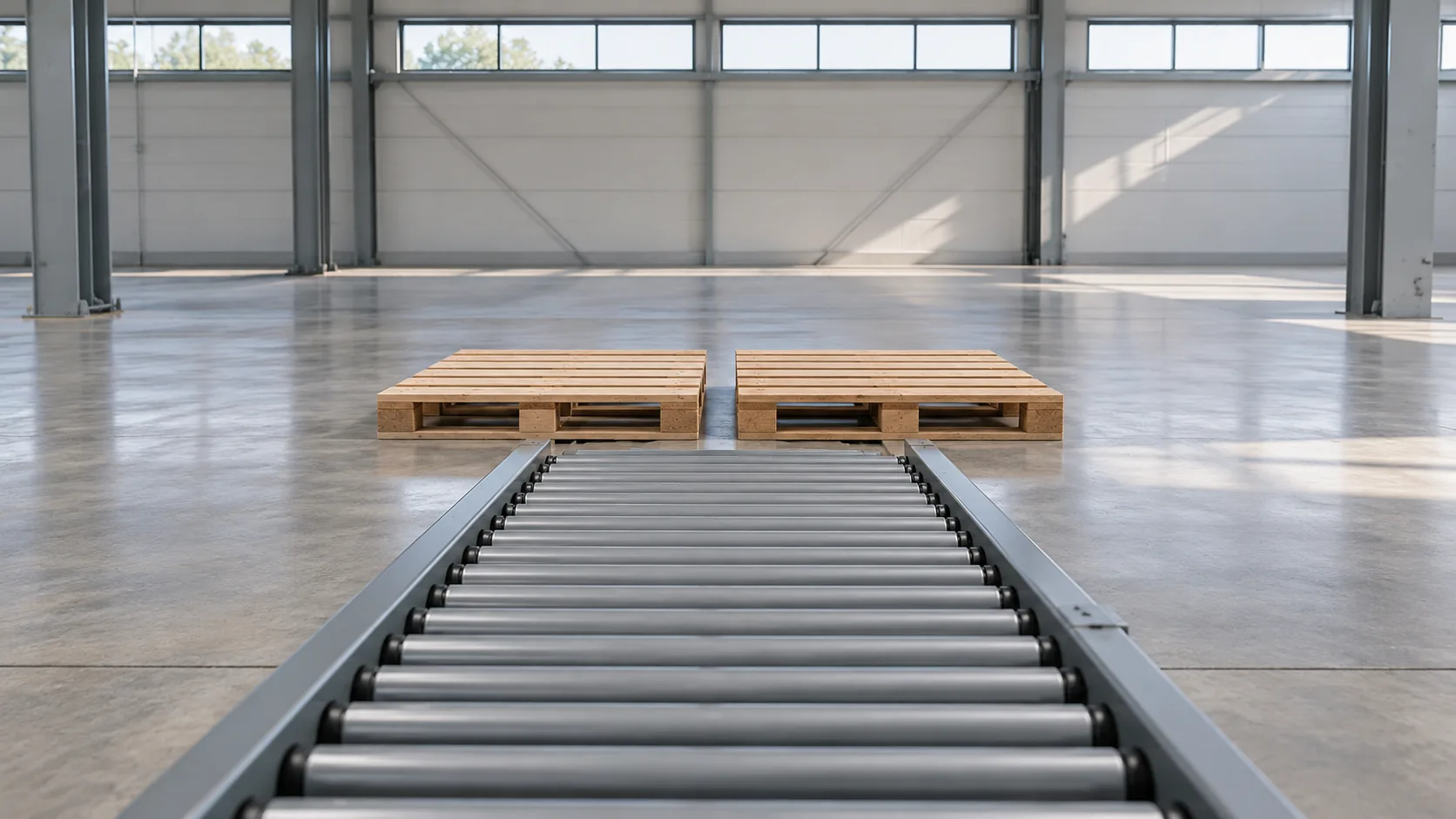
A palletizer that finishes a load before the next empty pallet is in place stops the infeed, and the cases behind it fail to move. At an illustrative 12 cases per minute, a 24-case load takes 2 minutes. The Hamer pallet dispenser page states 2+ pallets per minute, which is one pallet every 30 seconds at that floor, and a magazine of up to 15 empties. The automation guide already uses the 12-case figure for a 30-second buffer. This page is the layout those cases enter. It is not a cell rating and it does not assign a palletizer model to LINEVO.
The infeed and the empty pallet are one timing problem
| Record | What it prints | Dominant failure mode | Prevention |
|---|---|---|---|
| Automation guide, illustrative buffer | 12 cases per minute for 30 seconds is 6 cases: 12 × 30/60. | Treating 12 as a catalog rate. | Keep the word illustrative. Replace it with the plant’s counted rate. |
| Ti and Hi note, same style of illustration | 6 cases per layer and 4 layers is 24 cases. GS1 page 24 defines the two words. | Using 24 as a required pattern. | The count is 6 × 4. The drawing of the layer is a separate record. |
| nVenia Hamer pallet dispenser page, checked 20 October 2026 | Store up to 15 empty pallets. Discharge in-line or at 90 degrees. 2+ pallets per minute. Width and length each 30 to 48 inches. Height line printed as 4.5 to 5.5 feet. | Moving the 15 and the 2+ onto a different dispenser. | Quote them for this model page only. The height line is copied with the foot mark the page prints. |
| 29 CFR 1910.212(a)(1) and (a)(3)(ii), Cornell LII copy | Guard the operator and other employees from the point of operation, nip points, and rotating parts. The guard is designed so the body is not in the danger zone during the operating cycle. | Treating paragraph (a)(4), the drum interlock, as a palletizer-door rule. | (a)(4) names revolving drums, barrels, and containers. A pickup opening still needs a guard. It does not inherit that sentence. |
Rule of thumb
Rule of thumb. If the empty-pallet supply is slower than the load being finished, the infeed is the thing that stops. Build time in minutes is (Ti × Hi) / C, with C in cases per minute and the same case on every layer. At the illustrative 24-case load and 12 cases per minute, 24 / 12 = 2 minutes. A dispenser whose published floor is 2 pallets per minute supplies one pallet in 60 / 2 = 30 seconds. Thirty seconds is shorter than 2 minutes, so that floor is fast enough for this illustration and not a reason to skip the magazine refill.
One load, two positions
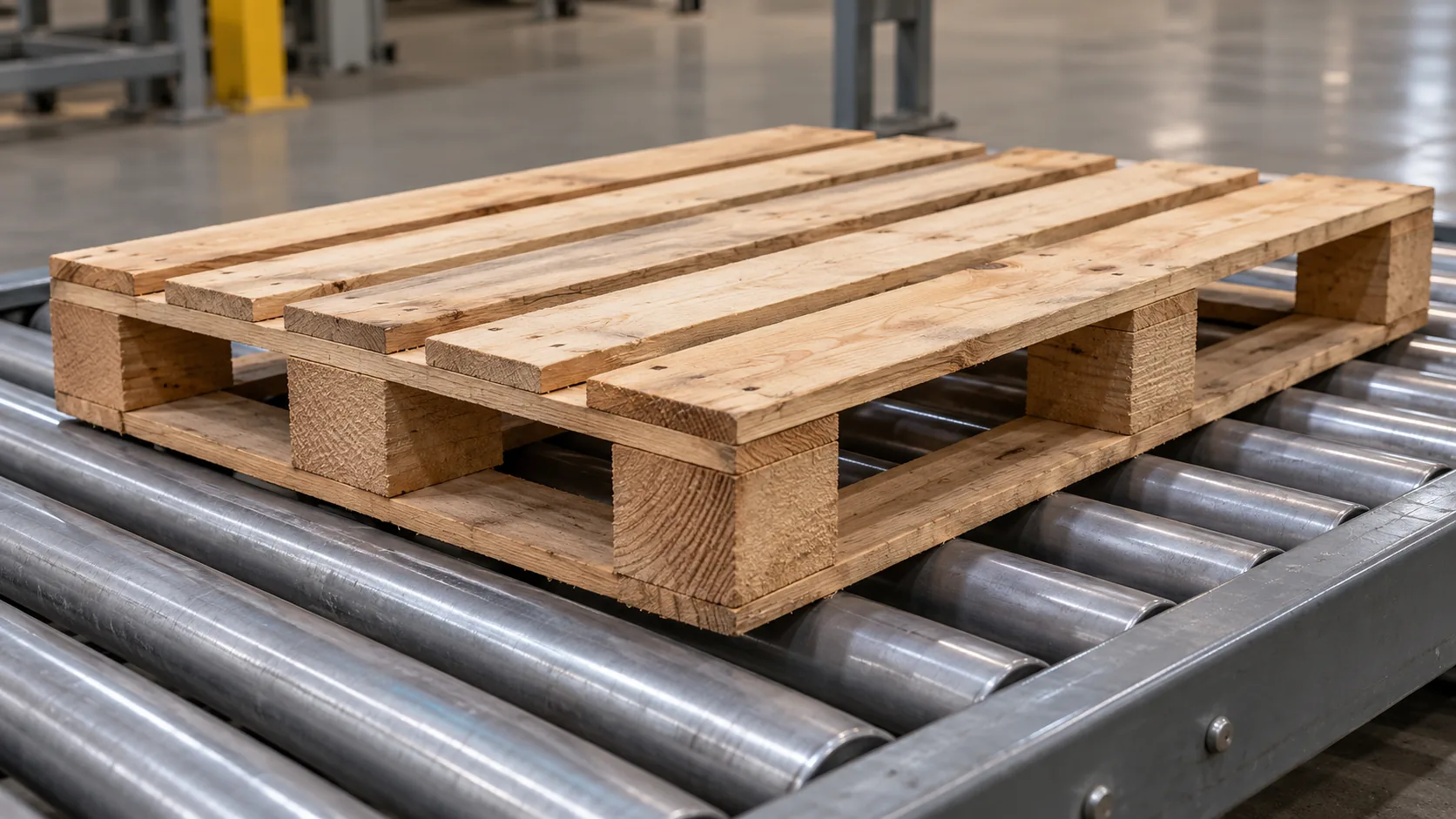
The build position and the removal position answer different questions. The build position has to be empty and square before the first case of the next load. The removal position has to be outside the moving mechanism before a forklift or a conveyor takes the load. Roller and chain pallet conveyors are the transport choice after that point. They do not set the case infeed.
Time to finish the illustrative load:
(6 × 4) / 12 = 24 / 12 = 2 minutes.
If the second position is already holding an empty pallet, the infeed can continue into the next load as soon as the pattern changes over. If the only empty pallet is still in the magazine, the changeover includes the dispense. At the published floor of 2 pallets per minute, that dispense is 30 seconds at the floor, plus whatever the page does not print: the time to square the pallet and confirm the photo eye. The Hamer page says photo eyes provide pallet status. It does not print the seconds between the eye and the first case.
A magazine of 15 empties, discharged at 2 per minute and not refilled, lasts:
15 / 2 = 7.5 minutes.
That is 7.5 × 60 = 450 seconds. In the illustration, a 2-minute load consumes one pallet, so 15 pallets are 15 loads, which is 15 × 2 = 30 minutes of building if the case rate stays at 12 per minute. The magazine’s 7.5 minutes at the dispenser floor is the time to push 15 pallets out, not the time the cell spends building. A forklift that refills the magazine only after it is empty arrives after the 15th pallet has already been called. The refill has to land before the magazine count hits the low-pallet alarm the same page lists. The page does not print the count at which that alarm trips.
The same page offers discharge in-line or at 90 degrees to the load direction, and it says the rate line once: 2+ pallets per minute. It does not print a second rate for the 90-degree option. The 90-degree choice changes where the pallet leaves, and therefore where the forklift or the takeaway conveyor stands. It does not, on that page, change the 2+ figure. Pallet width and length are each listed from 30 to 48 inches. A layout drawn for 48 inches of length does not automatically accept 30. The height line is printed as 4.5 to 5.5 feet. This note copies that mark and does not rewrite it as inches.
Two lines are a sum, until one stops
Two illustrative lines at 12 cases per minute present 24 cases per minute at the merge while both run:
12 + 12 = 24.
If the cell is planned for 18 cases per minute, the difference is 24 − 18 = 6 cases per minute. Over the automation guide’s 30-second interval that is 6 × 30/60 = 3 cases with nowhere in the cell. Those 3 cases are the buffer problem, not a conveyor length. A stopped line changes the sum. One line at 12 and one line at 0 is 12, which is under an 18-case plan, and the merge no longer needs the same buffer. The layout has to say which case is which when the lines are not the same product. The Hamer page is a bag-palletizer dispenser. It does not identify cases.
The pickup opening is a guard question, not an aisle width
29 CFR 1910.212(a)(1) requires one or more methods of machine guarding so the operator and other employees are protected from hazards such as the point of operation, ingoing nip points, and rotating parts. Paragraph (a)(3)(ii) says the point of operation of a machine that exposes an employee to injury shall be guarded, and the device shall be designed and constructed to prevent the operator from having any part of the body in the danger zone during the operating cycle. A forklift opening into a moving palletizer is that kind of zone if a person can reach the mechanism while it cycles. The section’s examples of methods include barrier guards and electronic safety devices. It does not print a distance from the pallet to the forklift mast.
Paragraph (a)(4) is the sentence that uses the word interlocked. It requires an enclosure interlocked with the drive so a revolving barrel, drum, or container cannot revolve unless the enclosure is in place. That sentence names those vessels. It is not a ready-made rule for a palletizer door. Copying it onto the door would cite the wrong machine. The door still has to meet (a)(1) and (a)(3)(ii). A layout that shows the forklift path and omits the guard has not finished the opening.
When this does not apply
- The case rate is not 12 per minute, or the layer is not 6 by 4. Then 2 minutes and 24 cases are the wrong inputs. Keep the division, replace the numbers.
- The dispenser is not the Hamer unit on the page checked 20 October 2026. The 15-pallet magazine and the 2+ rate do not transfer. The height mark stays on that page.
- Layers do not share one case count. Ti × Hi, as used here, assumes the same count on every layer. A partial top layer is a different total. The Ti and Hi note separates the count from the drawing.
- Someone uses 1910.212(a)(4) as the authority for a palletizer gate. That paragraph is about revolving drums, barrels, and containers.
Methods and sources
The 12 cases per minute and the 30-second interval come from the automation guide on this site, where they are marked illustrative. Six cases per layer and four layers are the same kind of illustration as the Ti and Hi note. GS1 US, framework R1.0, 12 February 2015, page 24, is the source for the two words. The magazine of 15, the 2+ pallets per minute, the in-line or 90-degree discharge, the 30 to 48 inch width and length, and the height line printed as 4.5 to 5.5 feet are the Hamer Brand pallet dispenser page on nvenia.com, read 20 October 2026. 60/2 = 30 seconds, 15/2 = 7.5 minutes, 24/12 = 2 minutes, and 12+12 = 24 are arithmetic on those figures. 29 CFR 1910.212 is quoted from the Cornell LII copy of the section. No palletizer cycle rate was taken from a catalog, and no aisle width was measured.
Sources and scope
Source dates refer to the material consulted, not independent performance verification.
- nVenia: Hamer Brand Pallet Dispenser
Magazine of up to 15 empty pallets, in-line or 90-degree discharge, stated rate of 2+ pallets per minute, pallet width and length 30 to 48 inches, and a height line printed as 4.5 to 5.5 feet.
Product page checked 20 October 2026 · Checked October 20, 2026 - 29 CFR 1910.212, General requirements for all machines
Guarding is required for the point of operation and other machine-area hazards. The interlock sentence in paragraph (a)(4) applies to revolving drums, barrels, and containers, not to a palletizer door.
Cornell LII copy of the eCFR section, checked 20 October 2026 · Checked October 20, 2026 - GS1 US National Data Quality Program: Framework
Page 24 defines TI as cartons per tier or layer and HI as tiers or layers per pallet. Used for the words only.
R1.0, 12 February 2015 · Checked October 20, 2026
Published by DeltaSpark. Editorial policy · Corrections and contact
Continue reading
Ti and Hi on a Pallet: What the Two Numbers Mean for a Palletizer Layer Program
Understand Ti and Hi, translate cases per layer and layer count into a palletizer recipe, and recognize when mixed or partial layers need more detail.
Read articleEnd-of-Line Packaging Automation: A Guide to Planning the Process
Define the packaging sequence, accepted outputs, buffers and supply boundaries before requesting an end-of-line automation proposal.
Read articleRoller vs. Chain Pallet Conveyors: What to Check Before Specifying a System
Compare roller and chain pallet transport by underside support, travel direction, transfer geometry and loaded-pallet acceptance trials.
Read article