
End-of-Line Packaging Automation: A Guide to Planning the Process
Define the packaging sequence, accepted outputs, buffers and supply boundaries before requesting an end-of-line automation proposal.
Updated October 20, 2026: Linked the palletizing infeed and empty-pallet layout note.
Start an end-of-line packaging project with the condition of the pack entering the line and the condition required at dispatch. Then specify the operations between them. Buying machines before defining those handoffs can leave an unassigned task, such as grouping cartons, rejecting incomplete cases or removing a finished pallet.
This guide covers process scope for discrete packs, cartons and shipping cases. It does not size a particular machine or establish a safe machinery layout.
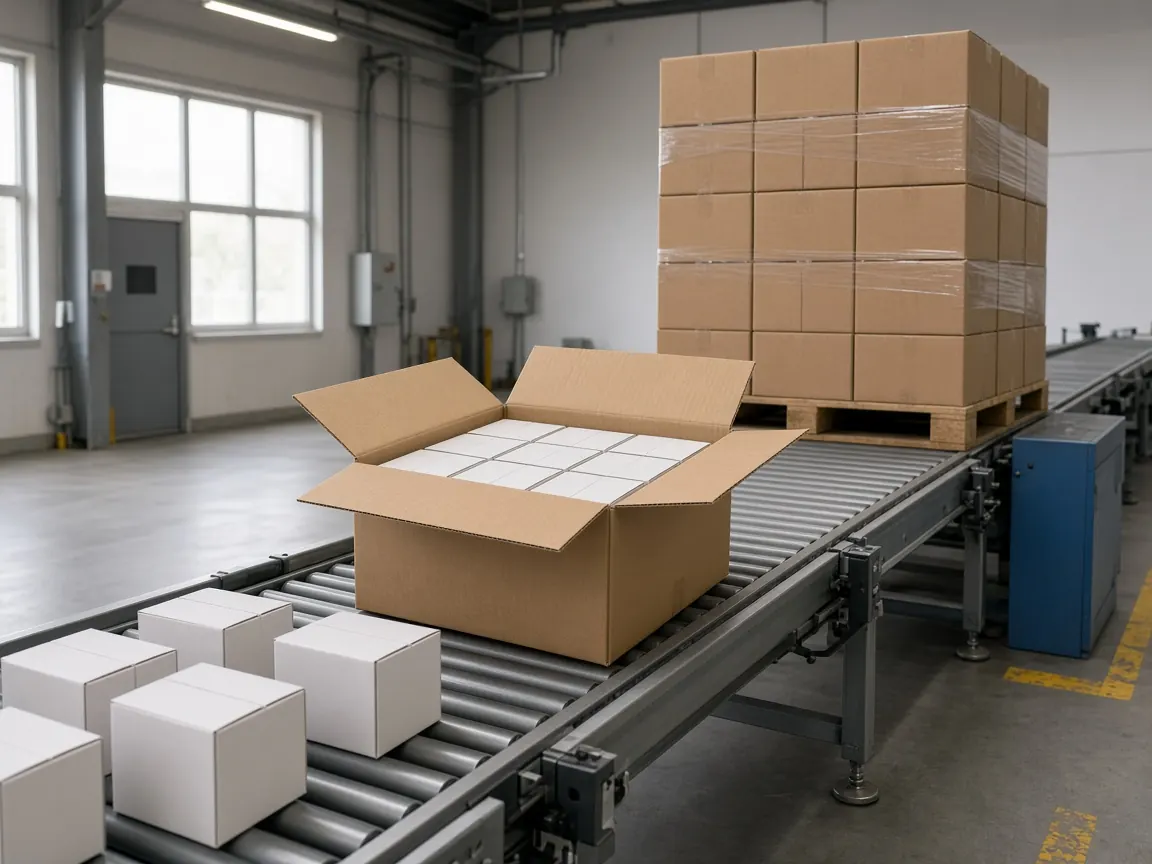
Illustrative photograph. The carton step is optional; use the packaging layers your product actually needs.
Describe the pack at each handoff
A retail carton and a shipping case are different outputs, even when suppliers use “box” for both. Record a drawing or sample identifier alongside the name. Use the cartoning and case-packing comparison if the packaging layers are still unclear.
| Handoff | Input to define | Accepted output | Responsibility to assign |
|---|---|---|---|
| Primary pack to cartoner | Wrapped item or filled container; orientation and grouping | Correct count in a closed carton | Feeding, missing-item detection, reject handling |
| Carton to case packer | Carton size and required case pattern | Complete shipping case | Case supply, erection, loading, dividers if required |
| Case to palletizer | Closed case; identity and orientation | Agreed pallet pattern | Case spacing, recipe selection, empty pallet supply |
| Palletizer to dispatch | Completed but possibly unwrapped load | Released load with required containment and identification | Transfer, wrapping, labeling, removal and rejected-load access |
Not every installation needs every step. A shipping case may contain primary packs without retail cartons. A low-volume line may retain manual case loading while automating closure and palletizing. Draw the actual sequence before comparing automation scope.
Request output under a stated operating condition
Separate the required good-output rate from a machine’s catalog cycle rate. Give the supplier the product mix, changeover frequency, planned production time and acceptable reject definition. Ask which operations stop together and which can continue into a buffer.
For an illustrative buffer calculation, assume the upstream machine releases 12 cases per minute while a downstream interruption lasts 30 seconds. If upstream continues throughout, it creates six cases during that interval: 12 × 30/60. Existing work in progress, restart time and the space needed between cases are additional inputs. This arithmetic estimates one event; it does not establish a conveyor length or guarantee line capacity. The same 12-case illustration, the empty-pallet magazine, and a two-position removal layout are worked in the palletizing layout note.
Keep the quotation boundary visible
LINEVO’s published bar packaging and cartoning configuration describes a flow-wrapping-to-cartoning arrangement. The same page says reviewed technical ratings are not published. It therefore supports a discussion of process scope, not a claimed sustained output or proof that case packing, palletizing and wrapping are included.
In each proposal, mark the feeder, change parts, inspection, reject collection, conveyors, controls and installation as included, supplied by another party or unresolved. A named integrator should own the complete handoff list. The integration checklist turns those boundaries into interface records.
Agree what proves the line works
Choose representative products and packaging, including the difficult formats. Define good output, observation time, staffing, replenishment and permitted interruptions before the test. Include a downstream blockage, an incomplete pack, a recipe change and controlled recovery in the test discussion. Machine-state conventions such as PackML can make status exchange clearer, but the project still needs agreed signal meanings and behavior.
Prepare a process drawing, pack samples, SKU dimensions and weights, required good output, changeover schedule and a floor plan. Attach that information to the RFQ checklist and return to the end-of-line packaging guides for the individual equipment decisions.
Sources and scope
Source dates refer to the material consulted, not independent performance verification.
- LINEVO automatic cartoning machines
Carton opening, loading, closure and configuration boundaries.
undated; live page checked · Checked October 6, 2026 - LINEVO industrial bar packaging and cartoning line
Manufacturer lists flow-wrapping and cartoning integration; reviewed technical ratings are not published.
catalog-2026-09-26-full · Checked October 6, 2026 - OPC Foundation: PackML overview
PackML machine state and interface concepts; not a project safety specification.
online specification, checked 2026-10-06 · Checked October 6, 2026
Published by DeltaSpark. Editorial policy · Corrections and contact
Continue reading
Case Packing vs. Cartoning: What Each Process Does
Distinguish retail cartoning from shipping-case packing, specify the packaging layers and prepare samples that make machinery quotes comparable.
Read articleConnecting Packaging Machines, Conveyors and Palletizers: An Integration Checklist
Assign mechanical, controls and fault-recovery interfaces between packaging machines, conveyors and palletizers before approving the line design.
Read article
Palletizing infeed layout
Two illustrative lines at 12 cases a minute present 24. A published dispenser floor of 2 pallets a minute is 30 seconds. A late empty pallet stops the infeed.
Read article